
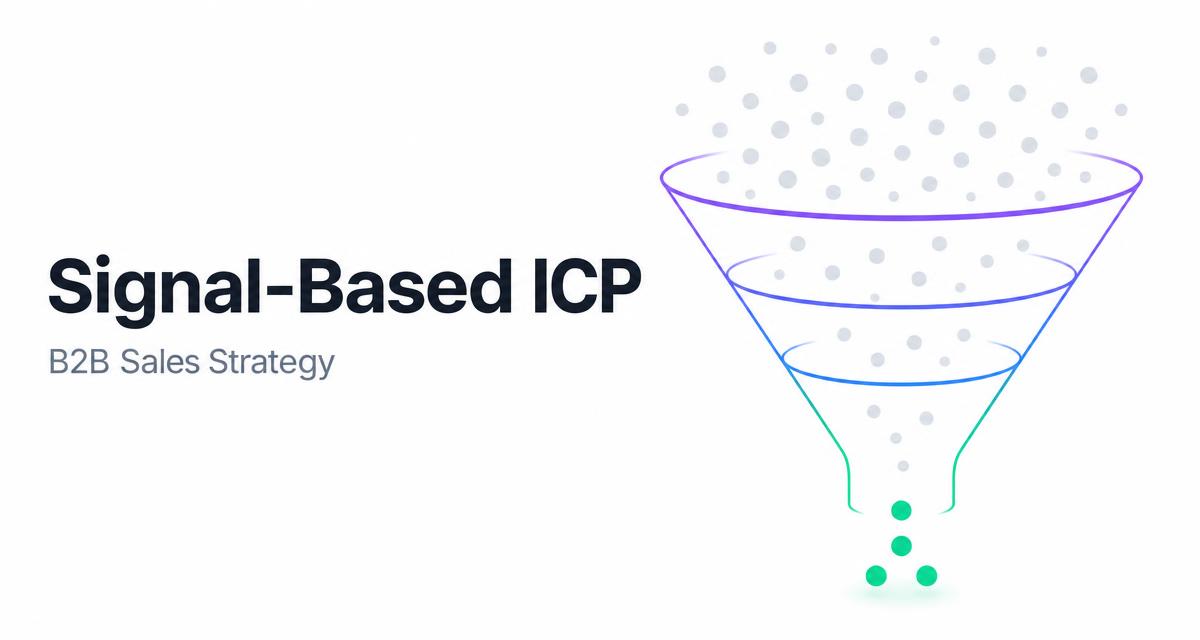
Somewhere in a spreadsheet, someone wrote: "CEO, tech company, 50-200 employees." That's not an ICP. It's a LinkedIn filter.
Here's what an actual ICP looks like on the same target: a company that just hired its first VP of Sales in the last 90 days, is actively posting for 2+ SDR roles, and has no dedicated RevOps hire yet.
Same firmographic bucket. Same job title, even. But these are two completely different ICPs, and only one of them tells you who to email this week.
The demographic ICP is a guess dressed up as a strategy
"CEO of a tech company" answers the question who could theoretically buy this? Almost anyone could theoretically buy anything. That's exactly the problem.
Gartner research shows B2B buyers now complete 70% or more of their research before they ever engage a sales rep, a pattern Forrester's ongoing buying-behaviour studies echo. By the time your outreach lands, most of the people on your demographic list have already decided whether they care, and you weren't in the room for it.
That's why cold email results have been sliding for years. Not because the message is bad, but because the targeting is blind. The average B2B decision-maker now gets dozens of cold emails a week, and reply and connect rates have been eroding year over year across ZoomInfo's benchmarks.
A demographic ICP doesn't fail because the list is wrong. It fails because it can't tell the difference between someone who fits your product and someone who needs it right now. The CEO in your original ICP might be a perfect fit and still be eight months away from caring. The signal-based version of that same company, the one hiring its first VP of Sales, is telling you in real time that the problem you solve just became urgent.
If your sequences are already built and still underperforming, the fix is usually upstream. We walk through the full diagnostic in why your cold email isn't failing because of your subject line.
What actually separates the two ICPs
Same company, two ICPs. Here is the layer missing from the demographic version, and what replaces it.
Trigger events
The timing layer. A company hiring its first several SDRs is signalling a buying window that touches CRM upgrades, sales engagement tools, intent data and lead scoring, usually within 90 days of that first hire.
Technographics
The fit-and-reason layer. What's already in the stack tells you whether you fit and whether there's a reason to switch: a competitor tool in place, a recent migration, or a fresh SOC 2 certification.
Disqualifiers
The exclusion layer. Existing customers, companies with an in-house team already solving the problem, and past lost deals with no new trigger since. This layer alone often cuts a "qualified" list by a third.
The same account, run through all three layers
| Layer | Demographic ICP | Signal-based ICP |
|---|---|---|
| Firmographics | CEO, tech company, 50-200 employees | CEO, tech company, 50-200 employees |
| Timing | Not considered | Hired first VP of Sales in the last 90 days, 2+ open SDR roles |
| Fit and reason | Not considered | Runs a competitor tool up for renewal, no RevOps hire yet |
| Exclusion | Not considered | Not a customer, not a past lost deal without a new trigger |
| Result | A long list of maybes | A short list of accounts in an active buying window |
Run a company through all three layers and "CEO of a tech company" becomes "CEO of a tech company that just hired its first VP of Sales, runs a competitor's tool up for renewal, and hasn't already turned us down." That's not a bigger list. It's a smaller, sharper one.
Running the process week to week
This only works if it runs continuously, not as a one-time list build. Four steps, repeated.
- Keep a live trigger-event watchlist. Signal decay is real. Research on intent-data freshness shows signals can expire within weeks, so a target that was hot in January may be irrelevant by April. Track hiring activity, funding news and leadership changes weekly, not quarterly.
- Score, don't binary-filter. A company hitting all three layers is a hotter lead than one hitting only the firmographic filter. Rank the list instead of just including or excluding.
- Turn the signal into the opening line. The trigger that qualified them is also your first sentence. "Saw you just brought on a VP of Sales" beats "Hope this finds you well" every time, because it's true, specific and timed to something real.
- Review closed-won and closed-lost monthly. Your best signal data comes from your own pipeline, not a vendor's database. If your last ten wins share a trigger, that trigger just earned a permanent place in your ICP.
Keeping that loop alive week after week is exactly the governance work most teams have nobody assigned to. We wrote about that gap in the fourth seat.
The difference shows up in the numbers
The only variable that changed was whether the target was chosen by title or by timing.
That comparison comes from Salesmotion's 2026 prospecting benchmarks, cited in Lead Scorer's field guide to buying-signal-driven outbound. It isn't an independent research house like Gartner or Forrester, so treat it as an industry data point rather than a settled figure. It is consistent with the direction every other source in this space points: signal-timed outreach outperforms title-based outreach by a wide margin, not a marginal one.
Where this fits in your outbound engine
"CEO of a tech company" will always be a legitimate starting filter. It just isn't an ICP on its own. It's the first of four layers, and the one every other outbound team already has.
At Vara Tech, this signal layer is the part most outbound engines skip. Not because it's hard to explain, but because it's hard to run consistently without the data going stale. We don't automate the sending. We build the signal-based targeting and governance underneath it, so outreach reaches people who are actually in-market, not just people who fit a filter.
See how that runs in practice in our client case studies, compare it with hiring in hybrid sales function vs hiring an SDR, or look at the engagement tiers.
Frequently asked questions
What is a signal-based ICP?
A signal-based ICP layers timing and behaviour on top of firmographics. Instead of stopping at industry, size and job title, it adds trigger events such as a first VP of Sales hire, technographic signals such as a competitor tool up for renewal, and disqualifiers such as existing customers or past lost deals with no new trigger.
How is an ICP different from a buyer persona?
An ICP describes the company you should sell to. A persona describes the individual inside it. A signal-based ICP tells you which accounts are in-market this week; the persona tells you who inside that account to write to and what they care about.
Which trigger events matter most for B2B outbound in India?
Leadership hires in sales or revenue roles, funding rounds, new SDR or RevOps job postings, CRM or tooling migrations, compliance certifications such as SOC 2 or ISO, and expansion into a new city or export market. These signal an active buying window, usually within 90 days.
How often should the ICP be refreshed?
Trigger data decays within weeks, so the watchlist should be refreshed weekly. The ICP definition itself should be reviewed monthly against closed-won and closed-lost deals, because your own pipeline is better signal data than any vendor database.
Does signal-based targeting really improve reply rates?
Industry prospecting benchmarks for 2026 put signal-based outreach at 15 to 25% reply rates against 1 to 5% for generic cold outbound, with win rates roughly double. Treat those as an industry data point rather than settled research, but the direction is consistent across sources.
Find out if your ICP is a filter or a strategy
Book a free 30-minute Sales Diagnostic. We'll pressure-test your current target list against trigger events, technographics and disqualifiers, and show you what a signal-based version of it looks like. No pitch attached.
Book Free Diagnostic →Sources
- Gartner and Forrester B2B buying-behaviour research on pre-engagement research share
- ZoomInfo cold outreach benchmarks on declining reply and connect rates
- Salesmotion 2026 prospecting benchmarks, cited in Lead Scorer's field guide to buying-signal-driven outbound